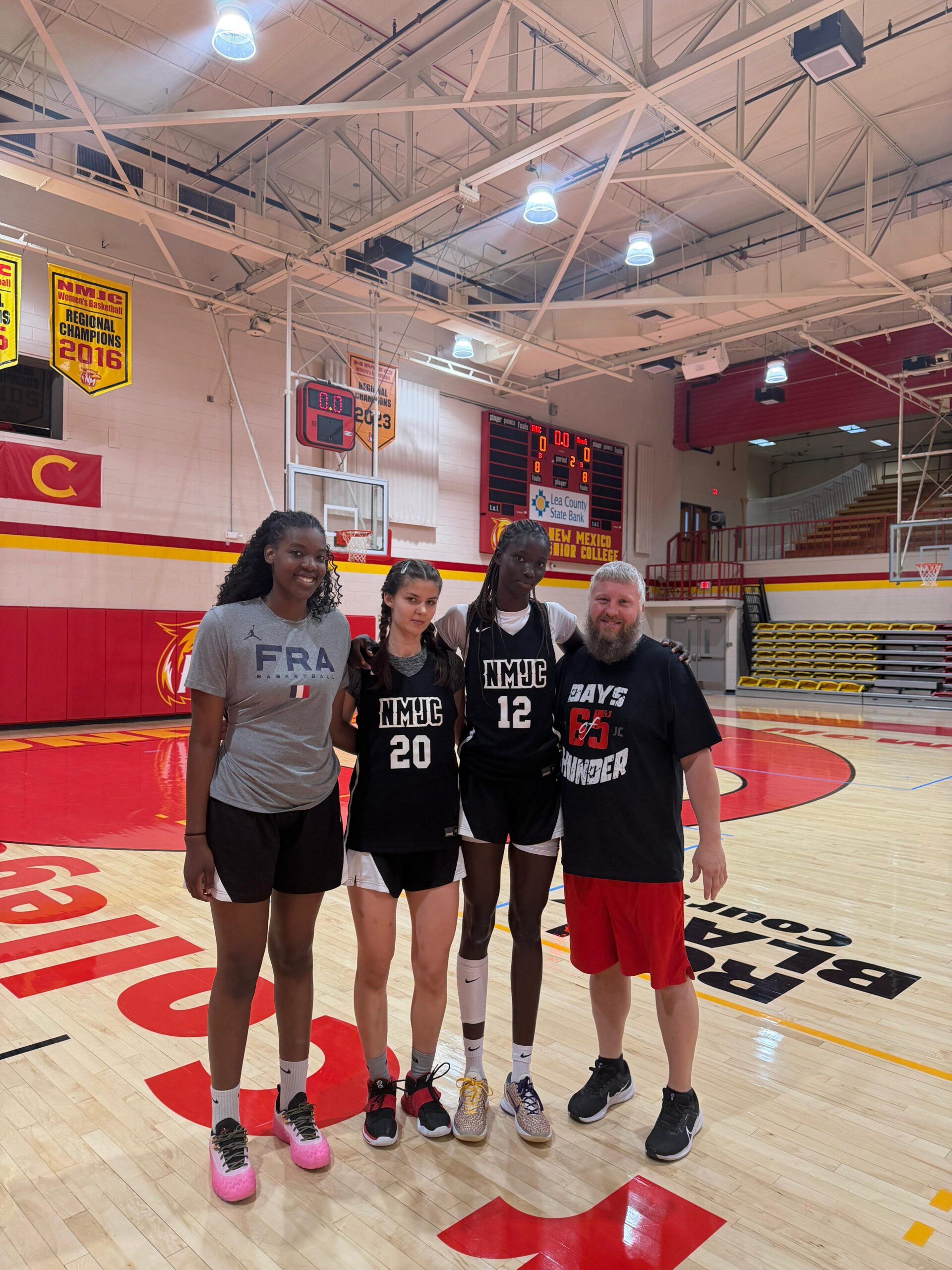
photo: Coach Austin Mefford, Head Women’s Basketball Coach at New Mexico Junior College,a four-time Conference Coach of the Year
with some of our international players.
For us, it is extremely important that our players do not simply attend a university or college, but become part of the strongest basketball programs and work with some of the highest-level coaches in America.
Why?
Because the better the coach, the better he understands the player. And the better he understands the player, the faster he can develop the player’s strengths, correct weaknesses, identify the right position, and integrate the player into the team.
This is especially important in American college basketball.
College Basketball Is Not Professional Basketball
College basketball is very different from professional basketball.
Professional teams are generally much more stable. A team can be built around one elite player. In the NBA, for example, an organization may acquire a franchise player and then build the entire team around that player.
Sometimes the opposite happens: a coach develops a particular system, and then the organization recruits players who fit that system.
A classic example is the Triangle Offense, which became famous through the Chicago Bulls and Los Angeles Lakers. That system requires specific types of players, specific skills, and a strong understanding of the game.
College basketball is completely different.
Every year, a college roster can change by 30–40%, 50%, 80%, or sometimes almost 100%.
That is why the ability of the coach is so important.
Every Season Almost Starts From Zero
A great coach must be able to do much more than simply coach players.
He must be able to build a new team almost every year.
Chipola College is a perfect example.
After a very successful season, a large number of Chipola players received opportunities to continue their careers at the NCAA Division I level. As a result, the coaching staff has to rebuild the team almost every year.
But if a coach can maintain the same high level of success after losing a significant portion of his roster, that is a true indication of coaching excellence.
That is why we value coaches such as Mitch Rolls at Chipola College and Austin Mefford at New Mexico Junior College.
A Winning Coach Is One of the Best Teachers
For a young player, working with a winning coach is not simply an opportunity to play for a successful team.
It is an opportunity to receive a much higher level of basketball education.
An elite coach can identify much faster:
- the position where a player can be most effective;
- the skills that need to be developed;
- the weaknesses that need to be corrected;
- the role the player can perform within the team;
- and the fastest way to integrate the player into the system.
When a player fits properly into a coach’s system, the results can come very quickly.
Sometimes a player needs time to adjust to a new country, a new system, a higher level of physicality, and new expectations. That is completely normal.
But when the coach identifies the right role and the player accepts the system, the player can develop extremely quickly.
Our Job Is Not Simply to Find a University
Our responsibility goes much further.
Our job is player development.
We do not look at a player as a one-season project: sign the player with the biggest-name university possible and then move on.
We look at a player as a developing basketball asset that should become better every single year.
Every season, the player should:
become stronger → receive better opportunities → move to the next level → receive a stronger offer.
That is why choosing the right first step is so important.
A player can sign with a very prestigious program but end up in a system where he or she does not develop properly, does not receive meaningful playing time, or has a role that does not match his or her abilities.
As a result, the career can move downward instead of upward.
The right program can produce a completely different result.
A player can start at the middle or even lower end of a particular level, but if the player develops, receives the right role, and works with the right coach, the next step should be up.
A Player’s Career Should Move Upward
We want to see a player’s development as a staircase:
Junior College → NCAA Division I → stronger NCAA Division I program → professional basketball.
Of course, every player’s path is different.
But the principle remains the same:
Every next step should make the player better and increase the player’s value.
That is why we are not simply looking for the most famous university.
We are looking for the right program, the right coach, and the right role.
Sometimes a less-famous program with an outstanding coach can give a player much more than a prestigious university where the player sits at the end of the rotation.
The True Art of Coaching
The true level of a coach is not determined only by the number of wins.
It is determined by whether the coach can build a successful team year after year, even when the roster changes dramatically.
If a coach loses ten players and his team remains competitive the following season and continues to be among the best teams in the conference and national rankings, that is a demonstration of true coaching excellence.
Such a coach does not simply know how to win.
He knows how to develop players, identify their proper roles, and rebuild a team.
Those are the coaches we want to work with.
That Is Why We Work With the Best
We strive to place our players in programs where they have the opportunity to work with high-level coaches such as Mitch Rolls at Chipola College and Austin Mefford at New Mexico Junior College.
Because for us, the most important question is not simply where a player is today.
The most important question is where that player will be one year, two years, and three years from now.
When the team wins, the player develops.
When the player develops, the player’s value increases.
When the player’s value increases, stronger opportunities become available.
And ultimately, everyone wins: the player, the team, the coach, and the program.
That is how we understand our responsibility to young basketball players.
Not simply finding a place for a player.
Not simply signing a contract.
But building the right path upward for the player’s career.